70+ Soulful Bible Verses About Love to Strengthen Your Vows
Affiliate Disclosure: Some links in this post are affiliate links. If you buy through them, I may earn a small commission at no extra cost to you.
Love is one of the Bible’s central teachings, describing a commitment marked by patience, kindness, sacrifice, faithfulness, and care for others. The best Bible verses about love show that biblical love is more than a feeling. It is expressed through actions, forgiveness, service, and a willingness to put another person’s good before your own.
Whether you are looking for Scripture about God’s love, romantic relationships, marriage, or loving others, the Bible offers clear guidance. From 1 Corinthians 13 to John 3:16, these passages can help you understand what genuine love looks like and give you meaningful words to share with someone you cherish.
Written and reviewed by the BlessingWish editorial team. Scripture selections are compiled with care to reflect Christian tradition and biblical teaching, and the content is reviewed periodically for accuracy.
These Bible verses about love offer some of Scripture’s clearest descriptions of genuine love. They speak about patience, kindness, sacrifice, faithfulness, forgiveness, and the lasting nature of love. You can use them for personal reflection, prayer, marriage, encouragement, or a meaningful message to someone you love.
“Love is patient, love is kind.” 1 Corinthians 13:4. This familiar passage begins by showing that genuine love is reflected in how we treat people. Patience and kindness are practical expressions of love.
“And now abideth faith, hope, charity, these three; but the greatest of these is charity.” 1 Corinthians 13:13. Love is placed above faith and hope as the greatest of these enduring Christian qualities.
“God is love; and he that dwelleth in love dwelleth in God, and God in him.” 1 John 4:16. This verse connects genuine love directly with knowing and abiding in God.
“We love him, because he first loved us.” 1 John 4:19. Our ability to love God begins with recognizing that His love came first. This verse points to the source of Christian love.
“For God so loved the world, that he gave his only begotten Son.” John 3:16. One of the Bible’s most recognized statements about love, this verse connects God’s love with the gift of His Son and the promise of eternal life.
“Greater love hath no man than this, that a man lay down his life for his friends.” John 15:13. Jesus presents sacrificial love as its highest expression. Love gives rather than seeking only personal comfort or gain.
“But God commendeth his love toward us, in that, while we were yet sinners, Christ died for us.” Romans 5:8. God’s love is shown through action. This passage emphasizes that Christ’s sacrifice came while humanity was still separated from God by sin.
“For I am persuaded, that neither death, nor life… shall be able to separate us from the love of God, which is in Christ Jesus our Lord.” Romans 8:38-39. These verses offer reassurance that nothing in creation can separate believers from God’s love in Christ.
“And above all these things put on charity, which is the bond of perfectness.” Colossians 3:14. Love holds Christian character together. The verse presents love as something believers are called to put into practice.
“And above all things have fervent charity among yourselves: for charity shall cover the multitude of sins.” 1 Peter 4:8. Biblical love encourages forgiveness and patience when relationships experience weakness or conflict.
“Hatred stirreth up strifes: but love covereth all sins.” Proverbs 10:12. This proverb contrasts the destructive effect of hatred with the peace-making quality of love.
“A friend loveth at all times, and a brother is born for adversity.” Proverbs 17:17. True love remains present during difficult circumstances. The verse highlights loyalty as an important part of meaningful friendship.
“With all lowliness and meekness, with longsuffering, forbearing one another in love.” Ephesians 4:2. Love requires humility and patience. Healthy relationships need people who are willing to show grace toward one another.
“But speaking the truth in love, may grow up into him in all things, which is the head, even Christ.” Ephesians 4:15. Biblical love does not require avoiding truth. Instead, truth should be communicated with care, honesty, and concern for another person.
“And the Lord make you to increase and abound in love one toward another, and toward all men.” 1 Thessalonians 3:12. Paul’s prayer shows that Christian love should continue growing and should extend beyond a small circle of close relationships.
Taken together, these Scriptures present love as patient, active, sacrificial, forgiving, truthful, and enduring. They provide a strong foundation for understanding the many forms of love described throughout the Bible.
The Bible presents God’s love as faithful, generous, sacrificial, and enduring. These Scriptures help explain why God’s love is different from human affection. His love is not based only on circumstances or changing emotions. Scripture repeatedly points to His willingness to seek, forgive, save, and remain faithful to His people.
“God is love.” 1 John 4:8. This short statement gives one of Scripture’s clearest descriptions of God’s character. Love is not merely something God does. Love is central to who He is.
“For God so loved the world, that he gave his only begotten Son.” John 3:16. God’s love is demonstrated through giving. The verse connects His love for the world with the gift of Jesus Christ.
“In this was manifested the love of God toward us, because that God sent his only begotten Son into the world, that we might live through him.” 1 John 4:9. God’s love becomes visible through His action. He sends His Son so that people may have life through Him.
“Herein is love, not that we loved God, but that he loved us, and sent his Son to be the propitiation for our sins.” 1 John 4:10. Biblical love begins with God’s initiative. This passage directs attention away from human effort and toward His grace.
“We love him, because he first loved us.” 1 John 4:19. Understanding God’s love changes how believers respond to Him. Our love is a response to the love we have already received.
“But God commendeth his love toward us, in that, while we were yet sinners, Christ died for us.” Romans 5:8. God did not wait for people to become perfect before demonstrating His love. Christ’s death showed the depth of His grace toward sinners.
“Yea, I have loved thee with an everlasting love: therefore with lovingkindness have I drawn thee.” Jeremiah 31:3. This verse describes God’s love as everlasting and connects that love with lovingkindness.
“But God, who is rich in mercy, for his great love wherewith he loved us.” Ephesians 2:4. God’s great love is closely connected with His mercy. The passage reminds readers that salvation flows from His gracious character.
“For I am persuaded, that neither death, nor life… nor any other creature, shall be able to separate us from the love of God, which is in Christ Jesus our Lord.” Romans 8:38-39. Paul gives believers a powerful assurance that God’s love in Christ is not easily broken by circumstances.
These passages show why God’s love is such a central theme in Scripture. His love reaches people through mercy, sacrifice, forgiveness, and grace. For someone seeking reassurance, these verses can serve as a reminder that God’s care does not depend on having a perfect life or never making mistakes.
God’s love also provides the pattern for Christian love. Believers are called to receive His love and reflect it through compassion, patience, forgiveness, and service toward others.
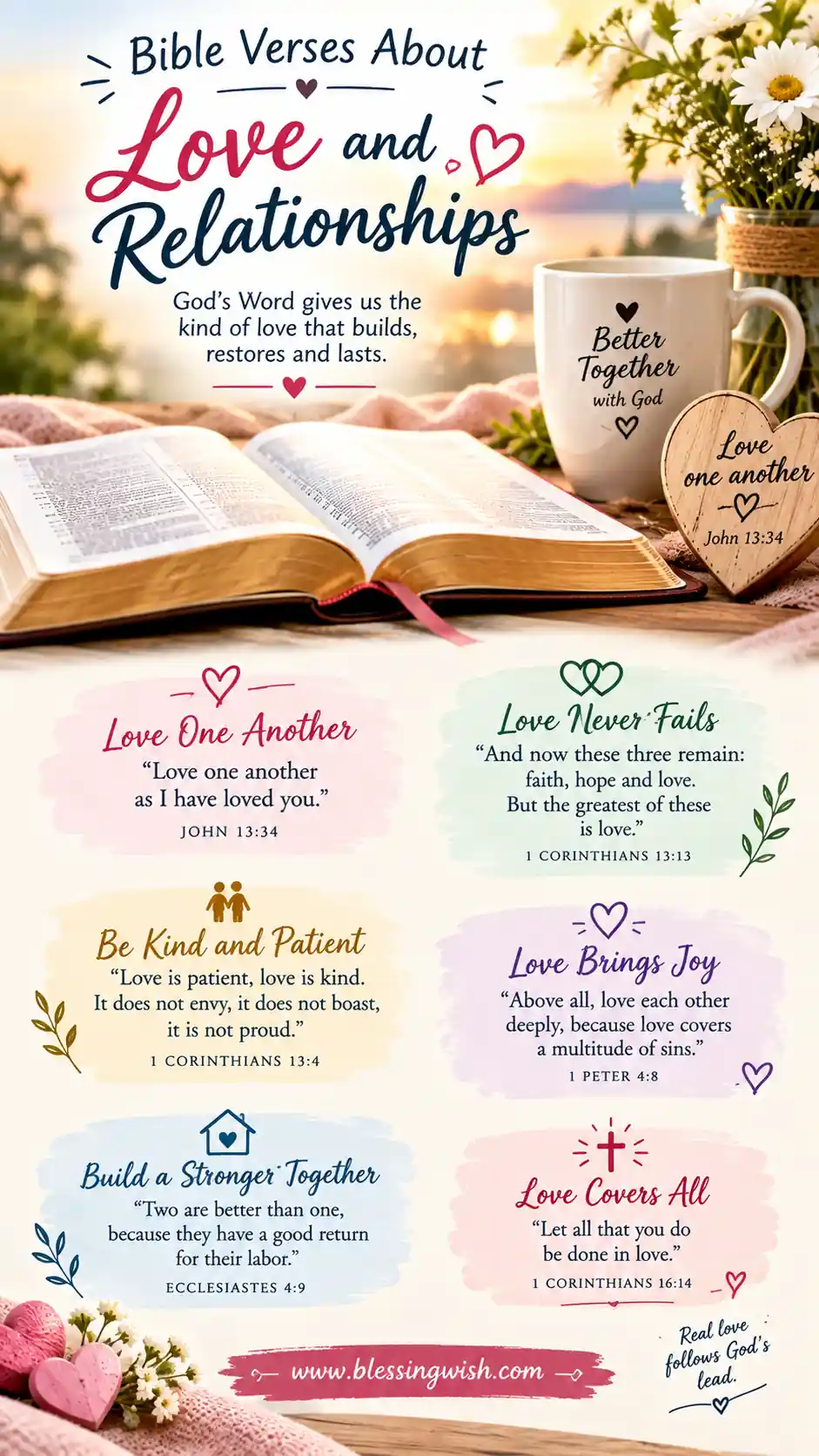
Healthy relationships require more than strong feelings. Scripture connects love with patience, humility, forgiveness, honesty, faithfulness, and genuine concern for another person. These Bible verses about love and relationships can help couples, friends, and family members think about how love should be expressed in everyday life.
“Love is patient, and is kind; love envieth not; love vaunteth not itself, is not puffed up.” 1 Corinthians 13:4. Love does not need to compete, boast, or prove its importance. It makes room for patience, kindness, and humility.
“Doth not behave itself unseemly, seeketh not her own, is not easily provoked, thinketh no evil.” 1 Corinthians 13:5. This passage describes love as considerate and self-controlled. It challenges people to move beyond selfish reactions when relationships become difficult.
“Beareth all things, believeth all things, hopeth all things, endureth all things.” 1 Corinthians 13:7. Love has endurance. It continues to hope and persevere rather than abandoning commitment whenever circumstances become challenging.
“And above all these things put on charity, which is the bond of perfectness.” Colossians 3:14. Love helps hold other virtues together. In relationships, it can shape how patience, forgiveness, humility, and compassion are practiced.
“With all lowliness and meekness, with longsuffering, forbearing one another in love.” Ephesians 4:2. Strong relationships require people to tolerate differences with humility and patience rather than responding to every disagreement with anger.
“Speaking the truth in love.” Ephesians 4:15. Honesty and love should work together. Healthy communication does not hide important truths, but it also avoids using truth as a weapon.
“And above all things have fervent charity among yourselves: for charity shall cover the multitude of sins.” 1 Peter 4:8. Love encourages forgiveness when people fall short. It does not mean ignoring serious wrongdoing, but it does call believers away from resentment and needless hostility.
“A friend loveth at all times, and a brother is born for adversity.” Proverbs 17:17. A meaningful relationship becomes especially visible during difficult seasons. Faithful love remains present when circumstances are uncomfortable.
“And the Lord make you to increase and abound in love one toward another, and toward all men.” 1 Thessalonians 3:12. Biblical love should grow. It is meant to reach beyond one romantic relationship and influence how believers treat people around them.
“And let us consider one another to provoke unto love and to good works.” Hebrews 10:24. Love can encourage positive action. A healthy relationship should help people become more willing to serve, encourage, and do good.
Biblical love also involves trust, forgiveness, and compassion. That does not mean every relationship will be perfect. People will disagree, disappoint one another, and need to apologize. Scripture gives believers a way to respond with grace while still valuing truth and wisdom.
For couples, these passages can serve as reminders that lasting love involves daily choices. Patience during disagreement, kindness during stress, honest communication, and forgiveness after mistakes all give practical meaning to biblical love.
A wife can be honored through words that reflect commitment, gratitude, tenderness, and faithfulness. These Bible verses about love for your wife provide meaningful Scripture for a card, anniversary message, prayer, wedding keepsake, or quiet moment of appreciation. They also point husbands toward the kind of selfless love Scripture calls them to practice.
“Husbands, love your wives, even as Christ also loved the church, and gave himself for it.” Ephesians 5:25. This is one of the clearest Bible verses for loving a wife. It calls a husband to a love marked by sacrifice, devotion, and self-giving rather than self-interest.
“So ought men to love their wives as their own bodies. He that loveth his wife loveth himself.” Ephesians 5:28. Marriage creates a close bond in which caring for your wife should be treated with the same seriousness as caring for yourself.
“For no man ever yet hated his own flesh; but nourisheth and cherisheth it.” Ephesians 5:29. The words “nourisheth” and “cherisheth” give this passage a tender dimension. Love within marriage should include care, protection, attention, and genuine concern.
“Whoso findeth a wife findeth a good thing, and obtaineth favour of the Lord.” Proverbs 18:22. This verse expresses gratitude for the gift of marriage and presents a loving wife as a blessing from the Lord.
“A virtuous woman is a crown to her husband.” Proverbs 12:4. A faithful and virtuous wife is described as a crown, highlighting the honor and strength she brings to her household and marriage.
“Her children arise up, and call her blessed; her husband also, and he praiseth her.” Proverbs 31:28. This passage encourages a husband to recognize his wife’s character openly rather than assuming she already knows how much she is valued.
“Many daughters have done virtuously, but thou excellest them all.” Proverbs 31:29. The verse provides a beautiful example of expressing admiration. A husband can use its spirit to acknowledge his wife’s unique qualities and contributions.
“I am my beloved’s, and my beloved is mine.” Song of Solomon 6:3. This poetic declaration expresses mutual belonging and affection. It can be meaningful for married couples celebrating their commitment to one another.
“Set me as a seal upon thine heart, as a seal upon thine arm: for love is strong as death.” Song of Solomon 8:6. The passage uses strong language to describe the depth and persistence of love between two people.
“Many waters cannot quench love, neither can the floods drown it.” Song of Solomon 8:7. This verse portrays love as something that remains valuable even when circumstances become difficult.
“Let every one of you in particular so love his wife even as himself.” Ephesians 5:33. Paul returns to the responsibility of a husband to love his wife with personal care and respect.
“Be kindly affectioned one to another with brotherly love; in honour preferring one another.” Romans 12:10. Although this verse is broader than marriage, its principles apply strongly to spouses. Affection, honor, and putting another person’s needs into consideration can strengthen married love.
“And above all these things put on charity, which is the bond of perfectness.” Colossians 3:14. Love provides an essential bond for Christian character. In marriage, it can shape how spouses respond to disagreement, weakness, stress, and change.
“With all lowliness and meekness, with longsuffering, forbearing one another in love.” Ephesians 4:2. Marriage requires patience. This verse reminds spouses that humility and endurance matter when two imperfect people share their lives.
“And let the peace of God rule in your hearts.” Colossians 3:15. A peaceful marriage does not mean the absence of disagreement. It means allowing Christian principles to guide how conflict is handled.
A Scripture verse becomes even more meaningful when paired with sincere personal words. You might write one verse inside an anniversary card and then explain one quality you appreciate about your wife. A short passage about patience can accompany a thank-you note, while Ephesians 5:25 can serve as a reminder of the sacrificial commitment marriage requires.
For a husband choosing Bible verses about love for his wife, the strongest passages are those that combine affection with action. Scripture points toward love that serves, honors, protects, forgives, and remains committed. Those qualities can turn a verse from a beautiful quotation into a meaningful part of married life.
Bible Verses About Love for Your Husband
Scripture also provides meaningful guidance for loving and honoring a husband. While the Bible does not contain a large collection of passages written specifically as “love verses for your husband,” many verses speak directly to marriage, faithfulness, encouragement, companionship, and mutual care. These passages can be shared in a card, anniversary message, prayer, or personal note.
“I am my beloved’s, and my beloved is mine.” Song of Solomon 6:3. This short declaration expresses mutual affection and belonging, making it a fitting passage for married couples.
“Let every one of you in particular so love his wife even as himself.” Ephesians 5:33. This verse places love and mutual respect at the heart of marriage and reminds husbands of their responsibility toward their wives.
“Two are better than one; because they have a good reward for their labour.” Ecclesiastes 4:9. Marriage involves partnership. This verse can remind couples that companionship and shared effort have lasting value.
“For if they fall, the one will lift up his fellow.” Ecclesiastes 4:10. A loving marriage provides support during weakness. Spouses can help one another through difficult circumstances rather than facing every challenge alone.
“Above all things have fervent charity among yourselves.” 1 Peter 4:8. Love should remain active and sincere within marriage, especially when spouses encounter mistakes or disagreements.
“Let us consider one another to provoke unto love and to good works.” Hebrews 10:24. A husband and wife can encourage one another toward faith, kindness, service, and good choices.
“Charity suffereth long, and is kind.” 1 Corinthians 13:4. Patience and kindness are essential qualities for a lasting relationship. This passage offers a practical description of how love should behave.
When choosing Bible verses for your husband, consider the quality you want to celebrate. A verse about companionship can highlight your partnership. A verse about faithfulness can honor your commitment. A passage about love and patience can encourage both of you during a challenging season.
The most meaningful Scripture does not need to sound romantic in every line. A verse that reflects loyalty, encouragement, sacrifice, or shared faith can speak deeply to married love because these qualities shape a relationship over time.
Biblical love is deeper than temporary attraction or changing emotion. The Bible describes true love through patience, kindness, sacrifice, faithfulness, forgiveness, and commitment. These Bible verses about true love show that genuine love is expressed through what a person does, especially when circumstances become difficult.
“Charity suffereth long, and is kind.” 1 Corinthians 13:4. True love makes room for patience and kindness. It does not depend entirely on getting your own way.
“Charity envieth not; charity vaunteth not itself, is not puffed up.” 1 Corinthians 13:4. Biblical love does not need to compete with others or constantly draw attention to itself.
“Doth not behave itself unseemly, seeketh not her own, is not easily provoked.” 1 Corinthians 13:5. Love is not defined by selfishness or uncontrolled anger. It considers how actions affect another person.
“Rejoiceth not in iniquity, but rejoiceth in the truth.” 1 Corinthians 13:6. True love is connected with truth and righteousness. It does not celebrate wrongdoing simply because it benefits someone we care about.
“Beareth all things, believeth all things, hopeth all things, endureth all things.” 1 Corinthians 13:7. Love has endurance. It continues to hope and remain faithful through ordinary difficulties.
“Charity never faileth.” 1 Corinthians 13:8. This famous statement points to the enduring character of love. Human relationships can change, but the biblical call to love remains.
“There is no fear in love; but perfect love casteth out fear.” 1 John 4:18. God’s perfect love provides confidence rather than condemnation for those who belong to Him.
“Herein is love, not that we loved God, but that he loved us.” 1 John 4:10. Scripture grounds Christian love in God’s initiative. His love comes first.
“Greater love hath no man than this, that a man lay down his life for his friends.” John 15:13. Jesus identifies self-sacrifice as the highest expression of love.
“Above all things have fervent charity among yourselves.” 1 Peter 4:8. Love should remain active and earnest rather than being reduced to words or temporary feelings.
The Bible’s idea of unconditional love should also be understood wisely. Loving someone does not mean approving every action, ignoring serious harm, or refusing healthy boundaries. Biblical love can include truth, accountability, wisdom, and forgiveness.
For couples, these verses provide a stronger foundation than romantic language alone. True love chooses patience when emotions are tense, kindness when stress is high, forgiveness when mistakes occur, and faithfulness when circumstances change. These qualities help turn biblical teaching into daily behavior.
Bible Verses About Loving Others
Jesus taught that love should extend beyond romantic relationships and close friendships. Believers are called to love God, love their neighbors, care for other people, and even respond to enemies with grace. These Bible verses about loving others show that Christian love is meant to shape everyday choices and interactions.
“Thou shalt love the Lord thy God with all thy heart, and with all thy soul, and with all thy mind.” Matthew 22:37. Love for God comes first. Jesus presents wholehearted devotion as the greatest commandment.
“Thou shalt love thy neighbour as thyself.” Matthew 22:39. Loving your neighbor means treating other people with the care, dignity, and consideration you would want for yourself.
“But I say unto you, Love your enemies, bless them that curse you.” Matthew 5:44. Jesus calls His followers to respond differently from ordinary human instinct. Love can remain present even when another person has acted against you.
“A new commandment I give unto you, That ye love one another; as I have loved you.” John 13:34. Jesus gives His own love as the standard for how believers should treat one another.
“By this shall all men know that ye are my disciples, if ye have love one to another.” John 13:35. Love becomes visible through behavior. It can show others what Christian discipleship looks like.
“My little children, let us not love in word, neither in tongue; but in deed and in truth.” 1 John 3:18. Biblical love requires action. Saying that you care matters, but helping and serving others gives those words substance.
“Let love be without dissimulation. Abhor that which is evil; cleave to that which is good.” Romans 12:9. Christian love should be sincere. It is not empty politeness or a performance designed to appear kind.
“Be kindly affectioned one to another with brotherly love; in honour preferring one another.” Romans 12:10. Believers are encouraged to show genuine affection and give others honor.
“And above all things have fervent charity among yourselves.” 1 Peter 4:8. Love should remain active within Christian community, especially when people have different personalities and weaknesses.
“And let us consider one another to provoke unto love and to good works.” Hebrews 10:24. Loving others includes encouraging them toward good actions rather than focusing only on personal needs.
Loving others can take simple forms. You can listen without interrupting, forgive an offense, encourage someone who feels discouraged, help a person in need, or speak truth with kindness. Scripture shows that love is visible in these everyday decisions.
The command to love your neighbor also broadens the meaning of biblical love. It is not reserved for people who agree with you or treat you perfectly. Christian love seeks the good of others while remaining guided by truth, wisdom, and obedience to God.
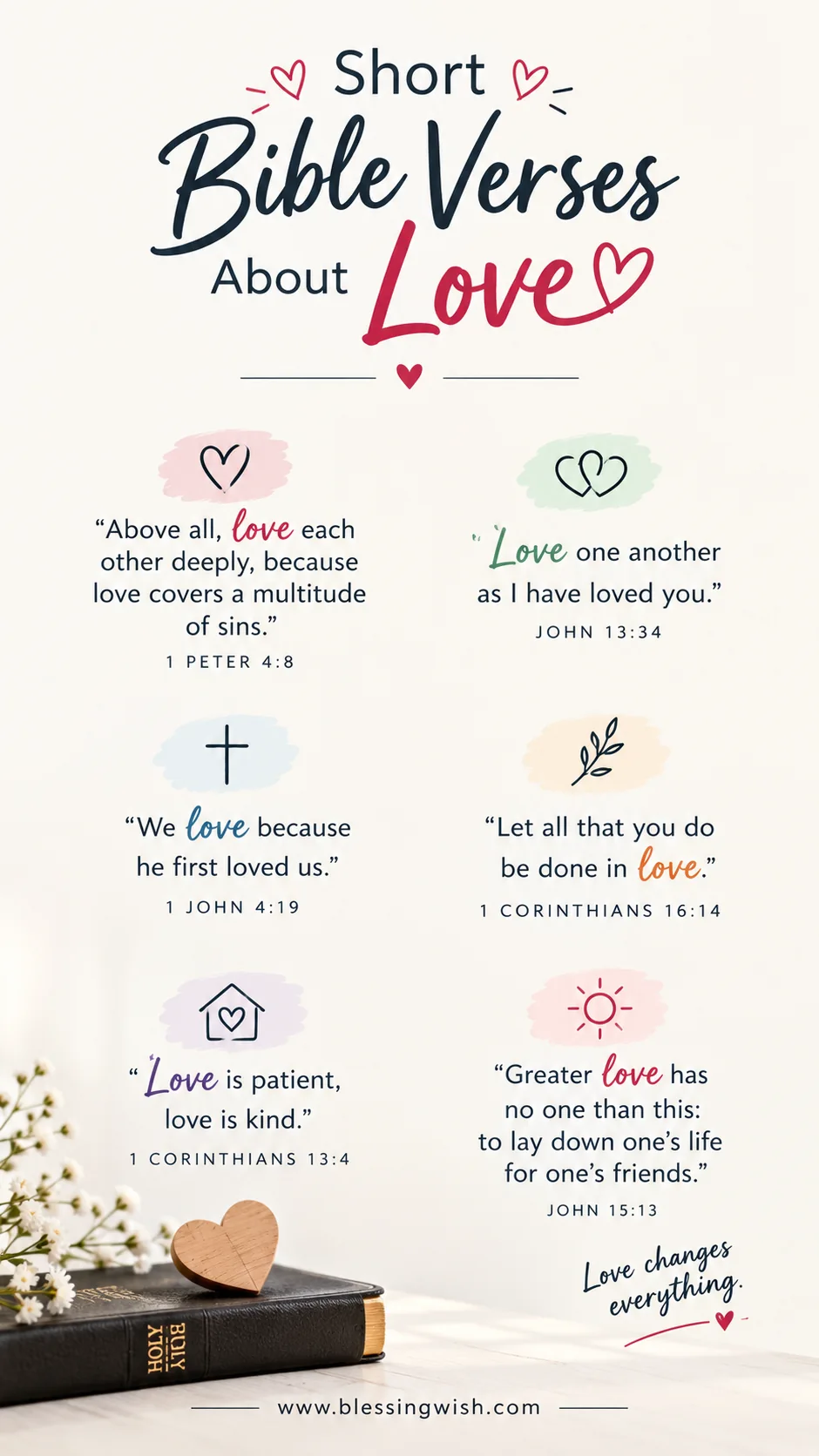
Sometimes a few words from Scripture are enough to express a deep truth. These short Bible verses about love are useful for texts, cards, captions, prayers, notes, and personal reflection. Each one offers a concise reminder of God’s love or the way Christians are called to love others.
“God is love.” 1 John 4:8
“We love him, because he first loved us.” 1 John 4:19
“Love never faileth.” 1 Corinthians 13:8
“Love is patient, love is kind.” 1 Corinthians 13:4
“Love one another.” John 13:34
“Love your neighbour as thyself.” Matthew 22:39
“Greater love hath no man than this.” John 15:13
“Perfect love casteth out fear.” 1 John 4:18
“Above all these things put on charity.” Colossians 3:14
“Let love be without dissimulation.” Romans 12:9
“Love covers all sins.” Proverbs 10:12
“Let us love one another.” 1 John 4:7
“Walk in love, as Christ also hath loved us.” Ephesians 5:2
“Abide in my love.” John 15:9
“My beloved is mine, and I am his.” Song of Solomon 6:3
“Charity suffereth long, and is kind.” 1 Corinthians 13:4
“Love… rejoiceth in the truth.” 1 Corinthians 13:6
“Be kindly affectioned one to another.” Romans 12:10
“Love worketh no ill to his neighbour.” Romans 13:10
“Above all things have fervent charity among yourselves.” 1 Peter 4:8
For a quick message, 1 John 4:8 is especially direct: “God is love.” For a romantic note, Song of Solomon 6:3 expresses mutual affection. For encouragement during a difficult season, 1 Corinthians 13:7 points toward enduring hope and perseverance.
Short Scripture can also be powerful when you pair it with your own words. Instead of sending a verse alone, add one sentence explaining why it reminds you of the person or situation. This makes the message personal while keeping Scripture at its center.
Romantic Bible Verses for Couples
Romantic love appears in Scripture alongside commitment, faithfulness, affection, companionship, and marriage. These romantic Bible verses can help couples find meaningful words for an anniversary, wedding, engagement, relationship milestone, or personal message. Song of Solomon provides some of the Bible’s most poetic expressions of romantic affection, while other passages explain the character that should support lasting love.
“I am my beloved’s, and my beloved is mine.” Song of Solomon 6:3. This intimate statement expresses mutual affection and belonging between two people.
“Set me as a seal upon thine heart, as a seal upon thine arm.” Song of Solomon 8:6. The image of a seal conveys a deep sense of devotion and commitment.
“For love is strong as death.” Song of Solomon 8:6. The verse describes love as powerful and enduring, giving it a seriousness beyond temporary attraction.
“Many waters cannot quench love, neither can the floods drown it.” Song of Solomon 8:7. This passage speaks about love that remains strong even when circumstances become difficult.
“My beloved is mine, and I am his.” Song of Solomon 2:16. The verse expresses mutual affection and a close bond between beloved partners.
“He brought me to the banqueting house, and his banner over me was love.” Song of Solomon 2:4. This poetic passage associates love with joy, affection, and delight.
“Two are better than one; because they have a good reward for their labour.” Ecclesiastes 4:9. A loving relationship involves partnership. Two people can support one another in work and in life.
“If one prevail against him, two shall withstand him; and a threefold cord is not quickly broken.” Ecclesiastes 4:12. The passage highlights strength through companionship and shared support.
“Charity suffereth long, and is kind.” 1 Corinthians 13:4. Romantic affection becomes stronger when it is accompanied by patience and kindness.
“Beareth all things, believeth all things, hopeth all things, endureth all things.” 1 Corinthians 13:7. Lasting love involves perseverance rather than depending only on pleasant emotions.
“Husbands, love your wives, even as Christ also loved the church, and gave himself for it.” Ephesians 5:25. For married couples, this verse connects love with sacrifice and committed service.
“And above all these things put on charity, which is the bond of perfectness.” Colossians 3:14. Love gives a relationship an important spiritual foundation.
A romantic Scripture works best when it matches the relationship and occasion. Song of Solomon may suit an affectionate anniversary message, while 1 Corinthians 13 can speak to the qualities needed for lasting love. For an engagement or wedding, passages about commitment and mutual care can carry more meaning than a verse chosen only because it sounds romantic.
Biblical romance is therefore closely connected with character. Affection matters, but Scripture also points couples toward patience, faithfulness, sacrifice, truth, and care. Those qualities give romantic love a stronger foundation.
Bible Verses About Love, Faith, Hope, and Strength
Love is closely connected with faith and hope throughout Scripture. These Bible verses about love and faith can encourage you when a relationship, friendship, family situation, or spiritual journey becomes difficult. They remind you that love can remain connected to trust in God, perseverance, and hope for better days.
“And now abideth faith, hope, charity, these three; but the greatest of these is charity.” 1 Corinthians 13:13. Paul places faith, hope, and love together while identifying love as the greatest.
“And hope maketh not ashamed; because the love of God is shed abroad in our hearts by the Holy Ghost.” Romans 5:5. Christian hope is connected with God’s love working within believers.
“And above all these things put on charity, which is the bond of perfectness.” Colossians 3:14. Love helps bind Christian character together and gives practical expression to faith.
“And the Lord make you to increase and abound in love one toward another, and toward all men.” 1 Thessalonians 3:12. Paul prays for love to grow. This suggests that Christian love can develop through practice and spiritual growth.
“And let us consider one another to provoke unto love and to good works.” Hebrews 10:24. Love and faith should encourage action. Believers can strengthen one another through kindness and good works.
“Beareth all things, believeth all things, hopeth all things, endureth all things.” 1 Corinthians 13:7. Love carries qualities that help people remain faithful during challenging circumstances.
“For I am persuaded, that neither death, nor life… shall be able to separate us from the love of God.” Romans 8:38-39. This passage gives believers confidence in the enduring nature of God’s love.
“We love him, because he first loved us.” 1 John 4:19. Christian love begins with receiving and recognizing God’s love.
“Walk in love, as Christ also hath loved us.” Ephesians 5:2. Love is presented as a way of life. It should influence how believers act, serve, and respond to others.
When love is tested, these passages can provide spiritual strength without pretending that difficult emotions do not exist. Faith gives you a reason to continue trusting God, while hope helps you look beyond the present situation.
Love and strength can also appear together in relationships. A couple may need patience during hardship. Friends may need to encourage one another through loss or uncertainty. Families may need forgiveness after conflict. Scripture gives each situation a different expression of love while keeping God at the center.
Bible Verses About Love and Marriage
Marriage brings love into a committed covenant marked by mutual care, faithfulness, sacrifice, patience, and honor. These Bible verses about love and marriage can be used for wedding readings, anniversary reflections, vows, cards, prayers, or personal study. They focus on the qualities that help married love remain strong through different seasons of life.
“Husbands, love your wives, even as Christ also loved the church, and gave himself for it.” Ephesians 5:25. This passage places sacrificial love at the heart of a husband’s responsibility toward his wife.
“So ought men to love their wives as their own bodies.” Ephesians 5:28. Marriage calls husbands to care for their wives with the same seriousness they would give themselves.
“Let every one of you in particular so love his wife even as himself.” Ephesians 5:33. The verse reinforces love as an ongoing responsibility within marriage.
“I am my beloved’s, and my beloved is mine.” Song of Solomon 6:3. This poetic declaration expresses affection, closeness, and mutual belonging.
“Many waters cannot quench love, neither can the floods drown it.” Song of Solomon 8:7. The passage speaks of love that remains valuable despite hardship.
“Two are better than one; because they have a good reward for their labour.” Ecclesiastes 4:9. Marriage involves partnership, shared work, and mutual support.
“For if they fall, the one will lift up his fellow.” Ecclesiastes 4:10. Spouses can support each other when one person becomes weak or faces a difficult season.
“And above all these things put on charity, which is the bond of perfectness.” Colossians 3:14. Love helps hold other Christian qualities together, making it essential within married life.
“With all lowliness and meekness, with longsuffering, forbearing one another in love.” Ephesians 4:2. Patience and humility can help spouses navigate differences without allowing every disagreement to damage their bond.
“Above all things have fervent charity among yourselves.” 1 Peter 4:8. Married love requires continued care, especially when mistakes and frustrations arise.
A strong marriage is built through repeated choices. A spouse listens instead of dismissing a concern, forgives instead of holding onto resentment, speaks truth without cruelty, and gives support when life becomes difficult. These everyday actions give biblical teachings about love a practical place within marriage.
For weddings, 1 Corinthians 13 remains a popular choice because it describes the character of love. For anniversaries, Song of Solomon can provide affectionate language, while Ephesians 5 can remind a married couple of the sacrificial commitment at the heart of Christian marriage.
The Bible’s teaching on marriage does not reduce love to romance. It connects affection with responsibility, honor, patience, service, and faithfulness. That broader view can help couples build a relationship that remains meaningful beyond the excitement of a single occasion.
Bible Verses About Love from Psalms and Proverbs
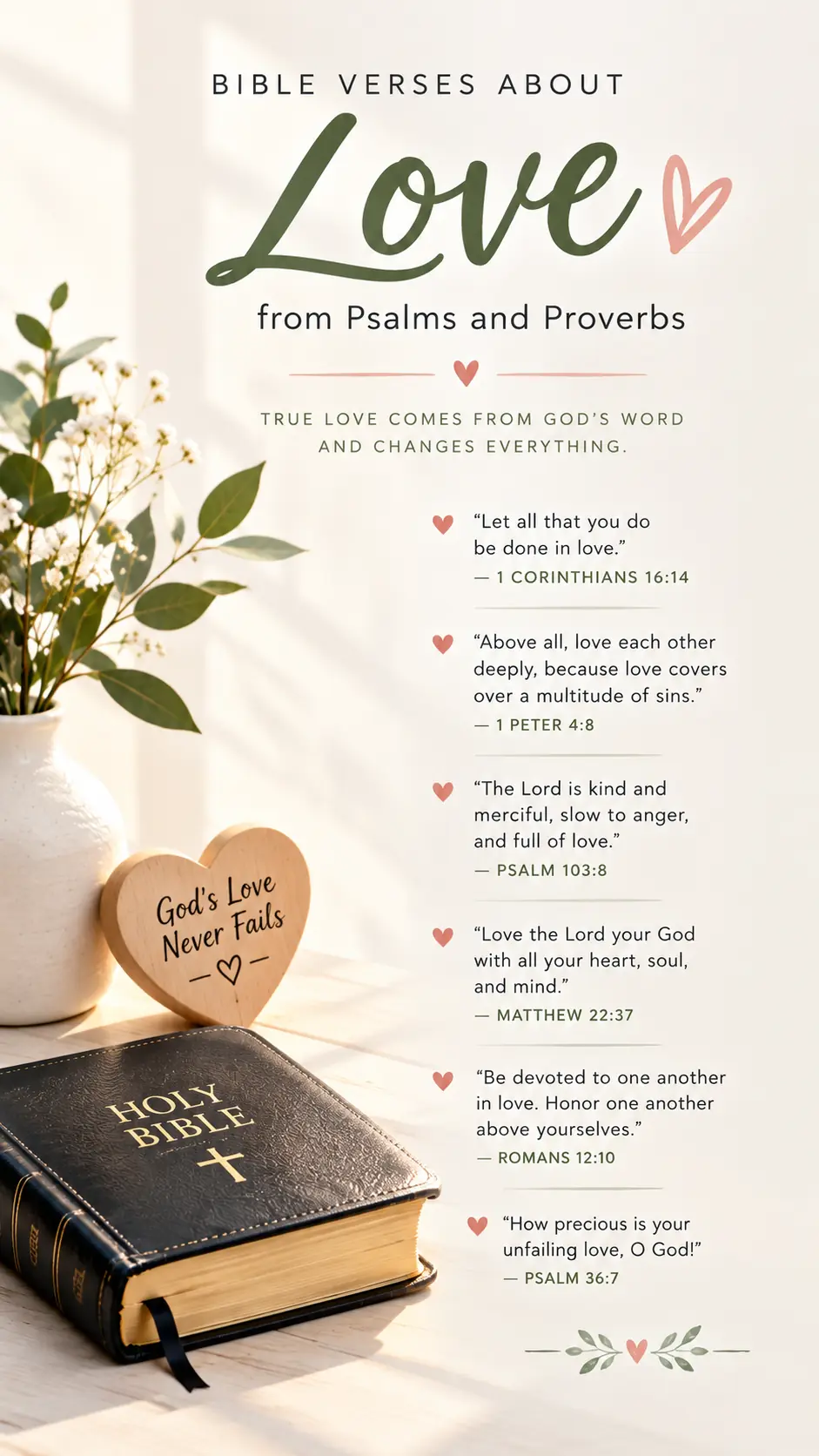
Psalms and Proverbs offer a different perspective on love. Their passages often connect love with faithfulness, friendship, forgiveness, wisdom, and God’s steadfast care. These verses can be especially meaningful when you want Scripture that sounds reflective, poetic, or practical.
“Hatred stirreth up strifes: but love covereth all sins.” Proverbs 10:12. This proverb contrasts the damage caused by hatred with the peace that can come through love and forgiveness.
“A friend loveth at all times, and a brother is born for adversity.” Proverbs 17:17. True friendship becomes especially meaningful during hardship. Love remains present when circumstances are difficult.
“A wholesome tongue is a tree of life.” Proverbs 15:4. Kind and thoughtful words can bring encouragement to another person. Love often appears in the way we speak.
“Better is a dinner of herbs where love is, than a stalled ox and hatred therewith.” Proverbs 15:17. This proverb shows that material abundance cannot replace peace and affection within a home.
“He that covereth a transgression seeketh love; but he that repeateth a matter separateth very friends.” Proverbs 17:9. The verse highlights discretion and forgiveness as qualities that can protect relationships.
“A friend loveth at all times.” Proverbs 17:17. This short statement captures the loyalty expected from genuine friendship.
“Faithful are the wounds of a friend; but the kisses of an enemy are deceitful.” Proverbs 27:6. Genuine love does not always tell us what we want to hear. A faithful friend can offer difficult but honest correction.
“A man that hath friends must shew himself friendly.” Proverbs 18:24. Meaningful friendship requires participation. Love and friendship grow through generosity, loyalty, and genuine care.
“The Lord is merciful and gracious, slow to anger, and plenteous in mercy.” Psalm 103:8. This passage describes God’s compassionate character and gives readers a picture of divine patience.
“But the mercy of the Lord is from everlasting to everlasting upon them that fear him.” Psalm 103:17. God’s mercy is described as lasting across generations, offering reassurance about His enduring care.
“O give thanks unto the Lord; for he is good: for his mercy endureth for ever.” Psalm 136:1. Psalm 136 repeatedly emphasizes God’s enduring mercy, making it a strong passage for reflecting on His faithful love.
“The earth is full of the goodness of the Lord.” Psalm 33:5. God’s goodness is presented as extending throughout creation.
“I will praise thee; for thou hast heard me, and art become my salvation.” Psalm 118:21. Gratitude is another response to experiencing God’s care and faithfulness.
Psalms often work well for prayer because they give language to both gratitude and difficult emotions. Proverbs, meanwhile, offers practical wisdom about how love should affect friendships and relationships.
Together, these books show that biblical love includes more than romance. It can mean remaining faithful to a friend, choosing forgiveness instead of resentment, speaking with kindness, and trusting God’s enduring mercy.
Bible Verses About Jesus’ Love
Jesus’ love is central to the Christian understanding of compassion, sacrifice, forgiveness, and service. The Gospels show Him caring for people, teaching His followers to love others, and ultimately giving His life for humanity. These Bible verses about Jesus’ love focus on both His words and the example He gave.
“Greater love hath no man than this, that a man lay down his life for his friends.” John 15:13. Jesus connects the greatest expression of love with self-sacrifice. His teaching presents love as something willing to give for another person’s good.
“As the Father hath loved me, so have I loved you: continue ye in my love.” John 15:9. Jesus invites His followers to remain in His love rather than treating love as a temporary emotion.
“This is my commandment, That ye love one another, as I have loved you.” John 15:12. Jesus makes His own love the standard for how His followers should treat one another.
“By this shall all men know that ye are my disciples, if ye have love one to another.” John 13:35. Christian identity is connected with visible love. The way believers treat others should reflect the teaching of Christ.
“For the Son of man is come to seek and to save that which was lost.” Luke 19:10. Jesus’ mission demonstrates His concern for people who are lost and in need of salvation.
“But when he saw the multitudes, he was moved with compassion on them.” Matthew 9:36. Jesus responded to people with compassion. His example shows that love notices suffering and responds with care.
“Suffer the little children to come unto me.” Matthew 19:14. Jesus welcomed children and treated them with attention and dignity.
“And Jesus wept.” John 11:35. This brief verse appears as Jesus responds to the death of Lazarus. It reveals His emotional response to human grief.
“As I have loved you, that ye also love one another.” John 13:34. Jesus does not leave love as an abstract idea. He gives His own behavior as a pattern for His followers.
“We love him, because he first loved us.” 1 John 4:19. Although written after Jesus’ earthly ministry, this verse summarizes the Christian response to God’s initiating love through Christ.
Jesus’ love combines compassion with truth and sacrifice. He cared for people in their suffering, welcomed those who were overlooked, taught forgiveness, and gave His life according to the Gospel account.
For someone seeking Scriptures about Christ’s love, John 13 and John 15 are especially useful starting points. They connect Jesus’ love with both sacrifice and the command to love others. His example shows that Christian love should move beyond words and become visible through service, compassion, patience, and self-giving.
Bible Verses About Love in the KJV
The King James Version uses the word “charity” in many passages where modern translations use “love.” For readers searching for KJV Bible verses about love, this traditional wording is especially familiar in passages such as 1 Corinthians 13. The verses below highlight some of the best-known KJV Scriptures on love.
“God is love.” 1 John 4:8. This concise statement identifies love as central to God’s character.
“We love him, because he first loved us.” 1 John 4:19. Christian love begins with recognizing the love God has already shown.
“Charity suffereth long, and is kind.” 1 Corinthians 13:4. The KJV uses “charity” for the self-giving love described throughout this passage.
“Charity envieth not; charity vaunteth not itself, is not puffed up.” 1 Corinthians 13:4. Love is presented as humble rather than competitive or boastful.
“Doth not behave itself unseemly, seeketh not her own, is not easily provoked.” 1 Corinthians 13:5. This verse connects love with self-control and consideration for others.
“Rejoiceth not in iniquity, but rejoiceth in the truth.” 1 Corinthians 13:6. Biblical love is aligned with truth rather than celebrating wrongdoing.
“Beareth all things, believeth all things, hopeth all things, endureth all things.” 1 Corinthians 13:7. Love is described as enduring, hopeful, and willing to persevere.
“Charity never faileth.” 1 Corinthians 13:8. This is one of the most recognizable KJV statements about the enduring nature of love.
“And now abideth faith, hope, charity, these three; but the greatest of these is charity.” 1 Corinthians 13:13. The passage places love above faith and hope in its lasting importance.
“Greater love hath no man than this, that a man lay down his life for his friends.” John 15:13. Jesus connects the highest form of love with sacrifice.
“Let love be without dissimulation.” Romans 12:9. The KJV wording calls believers toward sincere love rather than false or performative affection.
“And above all these things put on charity, which is the bond of perfectness.” Colossians 3:14. Love is described as a bond that holds Christian character together.
“And above all things have fervent charity among yourselves.” 1 Peter 4:8. The verse encourages believers to practice earnest love within their community.
For readers who prefer traditional biblical language, these KJV Scriptures offer familiar wording that works well for memorization, Bible study, wedding readings, cards, and personal devotion. The word “charity” in these passages should be understood in its biblical context as selfless, active love rather than simply financial giving.
How the Bible Defines Love
The Bible defines love through character and action rather than emotion alone. In 1 Corinthians 13, love is described as patient, kind, humble, truthful, forgiving, hopeful, and enduring. Other passages connect love with sacrifice, obedience to God, compassion, and genuine care for others.
Love is patient. “Charity suffereth long.” 1 Corinthians 13:4. Biblical love does not demand immediate perfection from another person.
Love is kind. The same verse says that love “is kind.” Genuine affection should produce considerate and helpful behavior.
Love is humble. Scripture says love does not boast or become proud. It does not need to make itself superior to others.
Love is not selfish. “Seeketh not her own.” 1 Corinthians 13:5. Biblical love considers another person’s good instead of focusing entirely on personal wants.
Love is not easily provoked. This does not mean ignoring serious problems. It points toward patience and self-control when emotions become intense.
Love rejoices in truth. 1 Corinthians 13:6 connects love with truth and righteousness. Genuine love does not require approving everything someone does.
Love perseveres. “Beareth all things, believeth all things, hopeth all things, endureth all things.” 1 Corinthians 13:7. Love has staying power when relationships encounter ordinary difficulties.
Love is sacrificial. Jesus said, “Greater love hath no man than this, that a man lay down his life for his friends.” John 15:13. Sacrifice shows that love can require giving rather than receiving.
Love comes from God. “God is love.” 1 John 4:8. Scripture places divine love at the center of Christian understanding.
Love should become action. “Let us not love in word, neither in tongue; but in deed and in truth.” 1 John 3:18. Love should be visible in what people do.
Love fulfills God’s command. Jesus taught believers to love God and their neighbors. Matthew 22:37-39. This makes love central to Christian obedience.
The Bible therefore presents love as a way of living. It includes affection, but it goes further. Love chooses patience when irritation would be easier. It offers forgiveness when resentment feels natural. It speaks truth without cruelty and serves others without demanding recognition.
This definition also explains why 1 Corinthians 13 remains one of the most important passages about love. It gives practical characteristics that can be examined in everyday relationships. If you want to know whether an action reflects biblical love, ask whether it shows patience, kindness, humility, truth, selflessness, and endurance.
Biblical love does not mean accepting every behavior or remaining in situations that cause harm. Love can exist alongside wisdom, boundaries, accountability, and truth. Its defining quality is that it seeks what is good while remaining faithful to God’s commands.
Final Thoughts
Bible verses about love remind us that biblical love is more than a feeling. Scripture connects love with patience, kindness, sacrifice, forgiveness, faithfulness, and truth. From God’s everlasting love to Christ’s sacrifice and the love shared between husbands, wives, families, friends, and fellow believers, the Bible gives clear guidance for loving others well.
When you face a difficult relationship, need encouragement, or want to strengthen your marriage, return to God’s Word. Let passages such as 1 Corinthians 13, John 15:13, 1 John 4:8, and Romans 5:8 guide your thoughts and actions.
Love grows stronger when it reflects God’s character. Choose patience when you are frustrated, forgiveness when you are hurt, kindness when someone needs encouragement, and faithfulness when circumstances become difficult. As you apply these Scriptures, let biblical love shape not only what you say, but also how you live each day.
Frequently Asked Questions
Which generation will not pass away?
Jesus says in Matthew 24:34, “This generation shall not pass, till all these things be fulfilled.” The statement appears in His teaching about the signs surrounding the end times and has been interpreted in different ways by Christians.
What is Proverbs 4:23?
Proverbs 4:23 teaches, “Keep thy heart with all diligence; for out of it are the issues of life.” The verse emphasizes guarding your inner life because your thoughts, desires, attitudes, and choices influence how you live and relate to others.
What is the sweetest verse in the Bible?
John 3:16 is often regarded as one of the sweetest and most comforting verses in the Bible because it describes God’s love for the world and His gift of His Son. It offers a concise message of love, sacrifice, faith, and salvation.
What is the greatest love verse in the Bible?
John 15:13 is widely considered one of the greatest love verses because Jesus says, “Greater love hath no man than this, that a man lay down his life for his friends.” The verse presents self-sacrificing love as its highest expression.
What does the Bible say about true love?
The Bible presents true love as patient, kind, humble, truthful, selfless, forgiving, and enduring. First Corinthians 13 is one of the clearest passages because it describes love through specific actions and qualities rather than treating it only as an emotion.
What Bible verse is best for marriage and love?
First Corinthians 13:4-7 is one of the most commonly chosen passages for marriage because it describes patience, kindness, humility, perseverance, and enduring love. Ephesians 5:25 is also important because it calls husbands to love their wives sacrificially.
What does the Bible say about God’s love?
The Bible repeatedly describes God’s love as faithful, enduring, compassionate, and sacrificial. John 3:16, Romans 5:8, Romans 8:38-39, and 1 John 4:8-10 are among the clearest passages about the depth and character of God’s love.
What is the most famous love chapter in the Bible?
First Corinthians 13 is widely known as the Bible’s love chapter. It explains the qualities of Christian love, including patience, kindness, humility, truth, endurance, and hope, and concludes that love remains greater than faith and hope.
Stay Blessed Every Week 💛
Get the latest blessings, prayers, uplifting quotes, and heartfelt wishes delivered straight to your inbox.